


.png)
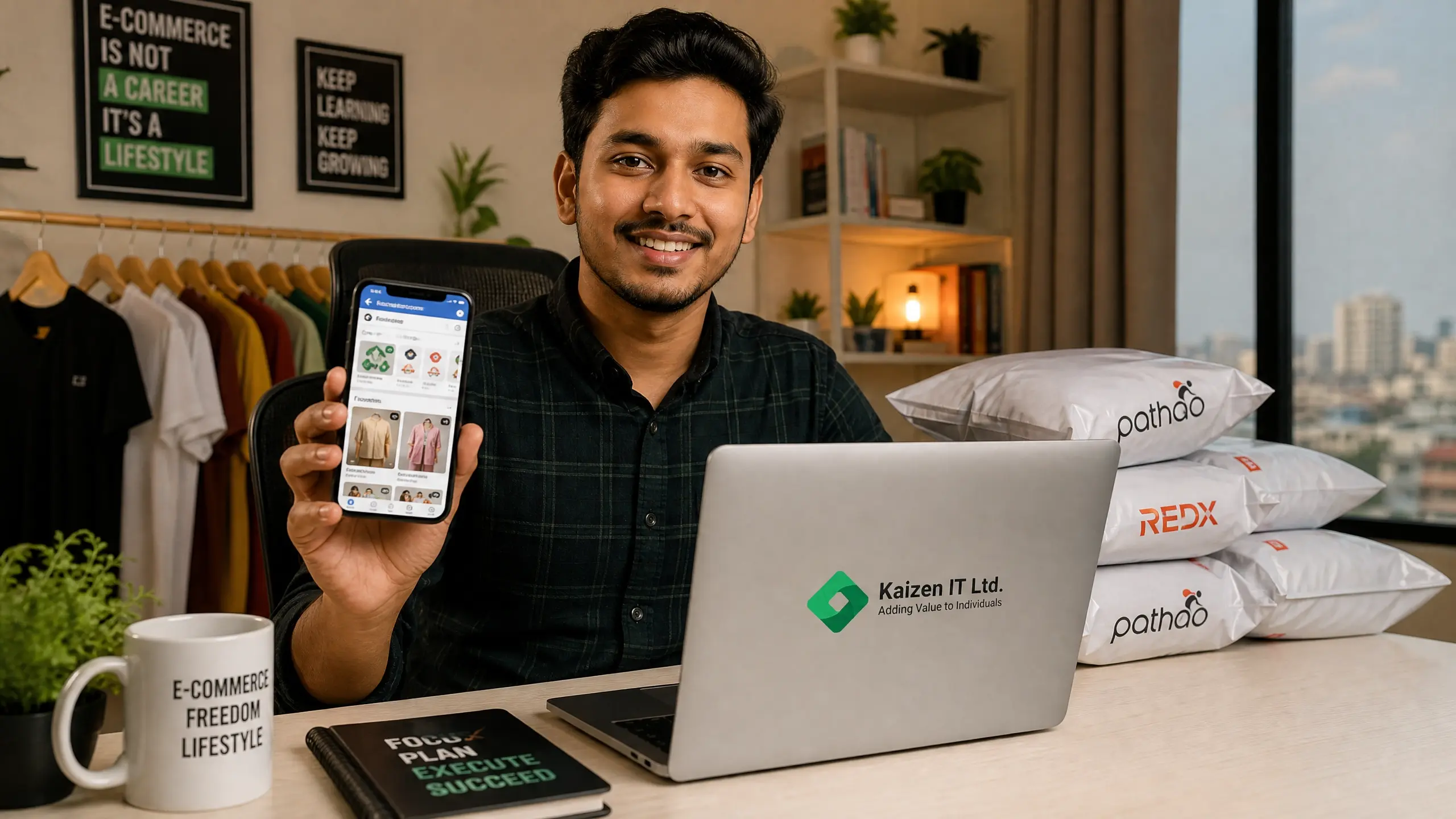
How to Start (and Actually Grow) a Successful F-commerce Business in Bangladesh in 2026
Every week, hundreds of new Facebook pages go live in Bangladesh selling everything from thrifted clothes to homemade snacks. Most of them look the same in month one: a few product photos, a handful of likes, maybe one or two sales from friends and family. Six months later, only a small number are still active. The rest quietly stop posting.
This is not a coincidence, and it is not bad luck. An F-commerce business in Bangladesh succeeds or fails based on a small number of decisions made in the first few weeks, followed by a small number of skills that either get learned or get skipped. This guide covers both halves of that story.
If you are just starting out, the first part shows you exactly how to set up your F-commerce business the right way from day one, so you skip the mistakes that quietly kill most new pages. If you already have a page but growth has stalled, stay for the second half — because the reason most pages plateau in Bangladesh has almost nothing to do with the product, and everything to do with a skill gap that is easy to fix once you know what it is.
What Is F-commerce? A Quick Explanation Before We Start
F-commerce means running a business through Facebook, Instagram, or WhatsApp — without needing a separate website. A customer sees your product post, comments "price koto?" or sends a message, you confirm the order over Messenger, take payment through bKash or Nagad (or arrange cash on delivery), and ship it through a courier like Pathao or RedX. No website. No developer. No hosting bill.
That is the entire appeal — and why it remains the most common way to start a business online in Bangladesh. Compared to a full e-commerce store, F-commerce needs almost no upfront technical investment, which is exactly why it attracts first-time entrepreneurs, home-based sellers, and side-hustlers who want to test an idea before committing real money to a website and warehouse.
But low barrier to entry cuts both ways. Because it is so easy to start an F-commerce page, competition inside every niche is intense, and the sellers who survive past year one are almost always the ones who treated it like a real business from day one — not a hobby with a Facebook page attached.
Part 1: Starting Your F-commerce Business the Right Way
Step 1 — Choose a Niche You Can Own
New sellers often try to sell "a bit of everything" hoping something sticks. This backfires. A page selling only baby products, or only handmade jewelry, or only imported skincare builds a much clearer identity in the buyer's mind than a page selling five unrelated categories. When someone scrolls past your page and sees ten different product types in one feed, their brain reads it as unreliable rather than convenient.
A focused niche also makes every other step in this guide easier. Your content calendar becomes simpler to plan, your ad targeting becomes sharper because you are speaking to one type of buyer instead of five, and your captions get easier to write because you are not switching tone between a baby onesie post and a skincare serum post in the same week.
Pick one lane. Master it — meaning you understand your suppliers, your pricing, your delivery timelines, and your customer's objections inside that one category. Expand later, once the first lane is genuinely profitable, not because growth has stalled and a new category feels like a fresh start.
Step 2 — Register Your Business Properly
Even a Facebook-only business needs a trade license in Bangladesh. As you grow, DBID (Digital Business Identity) registration and an e-TIN usually follow. Sellers who skip this early often run into problems later — payment gateways and courier services increasingly ask for this documentation, and retrofitting it after you already have paying customers is far more stressful than setting it up on day one.
Getting a trade license from your local City Corporation or Union Parishad office is a relatively short process, and it protects you in a few concrete ways: it lets you open a business bank account, it makes larger courier and payment-gateway partnerships possible later, and it gives customers a small but real signal that you are a registered, accountable business rather than an anonymous page. If your F-commerce business grows to a point where you are dealing in meaningful volume, an e-TIN also keeps you compliant with tax obligations before they become a bigger administrative headache.
Step 3 — Set Up Payment and Delivery
bKash and Nagad are essential — most Bangladeshi buyers will not order without one of these options readily available. Cash on delivery still matters for building trust with first-time customers who have never bought from you before and want to see the product before paying in full.
For shipping, Pathao, RedX, and Paperfly are the standard courier choices most F-commerce sellers rely on. Each has different strengths: some are faster inside Dhaka, others have better outside-Dhaka coverage, and pricing varies based on weight and distance, so it is worth testing more than one courier in your first few months rather than locking into a single provider before you know how they perform for your specific product type.
A detail many new sellers underestimate is packaging and the unboxing moment. A product that arrives well-packed, with a simple thank-you note or a small business card inside, does more for repeat purchases and word-of-mouth referrals than most sellers realize — and it costs very little to implement.
Step 4 — Build the Page Like a Brand, Not a Listing
Consistent product photography, a clear bio, saved quick replies for common questions, and a content calendar built around Bangladeshi shopping seasons — Eid-ul-Fitr, Eid-ul-Adha, Pohela Boishakh, and winter wedding season — all signal that you are running a real business, not a hobby page.
Quick replies are worth setting up early even for a brand-new page. Buyers in Bangladesh frequently ask the same handful of questions — price, delivery time, delivery charge, exchange or return policy — and a fast, consistent answer to these questions closes more sales than a beautifully written but slow reply. A five-minute delay in responding to "price koto?" is often the difference between a sale and a buyer who has already moved on to a competitor's page in the same feed.
Your content calendar does not need to be complicated. A simple monthly plan that maps out which products get promoted around which season — skincare gift sets before Pohela Boishakh, formal wear before Eid, warm clothing before winter — keeps your page relevant instead of reactive, and it means you are never scrambling to create content the week before a major shopping event.
Step 5 — Soft Launch Before You Spend on Ads
Sell to friends, family, and your existing network first. Use their feedback to fix pricing, delivery timing, or product issues before you put money behind ads. Spending on promotion before your offer is solid just means paying to expose your mistakes to a bigger audience.
This soft launch period is also where you collect your first genuine product photos in use, your first testimonials, and your first sense of which objections keep coming up — all of which become raw material for the ad copy and content you will need once you start spending on paid promotion.
Part 1.5: Beginner Mistakes That Quietly Kill New Pages
A few mistakes show up again and again in new F-commerce pages, and avoiding them from the start saves months of wasted effort:
Posting inconsistently in the first weeks, then disappearing for a week when sales are slow — the algorithm and your audience both reward pages that show up predictably.
Pricing purely by copying a competitor's price without accounting for your own delivery cost, packaging cost, and courier fees, which quietly erodes margin until the business feels unprofitable even with steady sales.
Treating every message the same way instead of tagging and following up with buyers who asked questions but did not purchase — a huge share of first-time inquiries convert on the second or third touch, not the first.
Launching in a niche with no clear differentiation from five other pages selling an identical product at an identical price, which forces the business into a race to the bottom on price instead of a competition on trust, service, or presentation.
Part 2: Why Most F-commerce Pages Plateau (And How to Fix It)
If your page already exists but sales have flattened, here is the pattern worth recognizing: the owner usually knows their product extremely well, but has never been trained in digital marketing. That gap shows up in four very specific places.
1. Captions and Copy That Do Not Convert
"Available now, DM for price" does not address why someone should buy today instead of scrolling past. Copy that works speaks to a specific hesitation — price, quality doubt, delivery worry — and answers it directly instead of just describing the product.
Consider the difference between a caption that lists features and a caption that addresses a real hesitation. A generic caption might say a dress is "beautiful, high quality, available in all sizes." A caption written with actual marketing skill acknowledges that the buyer has probably been disappointed by online quality before, and directly reassures them — with a photo of the fabric close-up, a note about the exact measurements, and a clear delivery timeline. The product might be identical. The conversion rate rarely is.
2. Boosting Posts Instead of Running Real Ads
The blue "Boost" button feels like advertising, but it rarely targets the right audience efficiently, because it optimizes for engagement rather than for the actual business objective — a sale, a message, or a checkout. Proper Meta Ads Manager campaigns, with defined audiences, clear objectives (Messages, Conversions, Traffic), and split-tested creative, consistently outperform boosted posts for the same budget.
The gap between boosting and running structured ads is rarely about spending more money — it is about spending the same money with intent, aimed at a defined audience and a defined outcome, instead of letting Facebook's default settings decide who sees the post.
3. Never Checking the Numbers
Most stalled pages have never opened Facebook Page Insights or looked at which ad actually drove a sale. Without this, every marketing decision is a guess repeated every month — the same ad budget gets spent on the same underperforming post because there is no data showing that a different post, a different audience, or a different time of day performed better.
Even basic tracking — knowing which posts generate the most messages, which ads generate the most cost-effective sales, and which days of the week produce the highest order volume — turns marketing from guesswork into a repeatable system that improves month over month instead of resetting to zero every time.
4. No System for Repeat Customers
Chasing new buyers constantly is expensive. Selling again to someone who already trusts you is far cheaper — but it requires a follow-up system: WhatsApp reminders, remarketing ads to people who visited the page or messaged before, and small loyalty offers for repeat buyers. Most F-commerce pages in Bangladesh have none of this in place, which means every month starts from zero instead of building on the customer base already earned.
None of these four problems are about talent. They are skills — the same skills taught in a structured digital marketing course, covering copywriting, paid social advertising, analytics, and customer retention as one connected system rather than scattered YouTube tutorials that each cover one piece without showing how they fit together.
A Simple Before-and-After Picture
Picture two F-commerce pages selling the same category of product, at similar prices, launched around the same time. Page A posts inconsistently, boosts the occasional post, replies to messages whenever there is time, and never looks at Insights. Page B posts on a set schedule tied to a content calendar, runs small structured Meta Ads campaigns with a clear objective, checks which ads and posts perform best each week, and follows up with past buyers through WhatsApp before major shopping seasons.
Both pages might start with the same product and the same budget. Within a few months, Page B is not just selling more — it is spending less to acquire each new customer, because every decision is based on what the data actually shows instead of what feels right. That gap is the entire difference this guide is pointing at: not better products, but better-applied marketing skill.
When Is It Time to Move Beyond Facebook Alone?
Once you are consistently taking more orders than you can manage manually in Messenger, it is usually time to add a proper online store alongside your Facebook presence. This also opens up visibility on Google search, not just inside Facebook's algorithm, which means customers can find you even when they are not already scrolling their feed.
But this transition only works if your marketing foundation is already solid — a website with no marketing skill behind it will struggle exactly the way an unmarketed Facebook page does. A website adds a new sales channel; it does not replace the need for the copywriting, ad targeting, and retention skills covered above. Sellers who add a website before fixing these fundamentals often end up managing two underperforming channels instead of one, which is why the marketing skill gap should be closed first.
Frequently Asked Questions
Do I need a trade license to run an F-commerce page in Bangladesh?
Yes. Even a Facebook or Instagram-based business is expected to hold a trade license, with DBID registration and e-TIN typically following as the business grows.
How much money do I need to start an F-commerce business?
Far less than a full e-commerce website. A small product batch and a modest ad budget are usually enough to test the market, which is exactly why F-commerce remains the most accessible starting point for new entrepreneurs in Bangladesh.
Why did my F-commerce page stop growing after a few months?
In most cases, it is not the product — it is the absence of a marketing system. No targeted ads, no performance tracking, and no repeat-customer strategy will cap growth no matter how good the product is.
Can I learn F-commerce marketing skills without a technical background?
Yes. Copywriting, Meta Ads, basic analytics, and customer engagement are practical, learnable skills — they do not require coding or a technical degree, which is why a structured short course is usually the fastest way to close the gap.
How long does it usually take to see results after fixing these marketing gaps?
Most sellers who apply structured copywriting, proper Meta Ads targeting, and basic analytics see a measurable change in message volume and cost-per-sale within four to eight weeks, since these are execution-level fixes rather than changes that require rebuilding the business from scratch.
Should I hire a marketing agency or learn these skills myself?
For a small F-commerce page, learning the core skills yourself is usually more cost-effective early on, since you understand your product and customers better than an outside agency would at this stage. As order volume grows and your time becomes the bottleneck, bringing in outside help for specific tasks like ad management becomes a more reasonable trade-off.
Is F-commerce better than opening a full e-commerce website in Bangladesh?
Neither is universally better — they serve different stages. F-commerce is the faster, cheaper way to test a product and build an early audience, while a full website adds search visibility and a more scalable checkout once order volume outgrows what Messenger can handle.
What is the difference between organic Facebook posts and paid Meta Ads for F-commerce?
Organic posts only reach people who already follow the page or happen to see it shared, which limits growth to your existing audience. Paid Meta Ads let a seller reach new, targeted buyers outside that existing audience, which is why relying on organic posts alone tends to plateau faster than a page that also runs structured ads.
How do I stop customers ordering and then not paying or receiving (fake orders) in F-commerce?
Confirming orders by phone call before dispatch, asking for a small advance payment on higher-value items, and keeping a simple record of repeat no-show customers are the most common ways F-commerce sellers in Bangladesh reduce fake or abandoned cash-on-delivery orders.
Take Your F-commerce Page From "Just Started" to "Actually Growing"
Whether you are about to post your first product or you have been stuck at the same monthly revenue for a year, the path forward is the same: learn the marketing skills that turn a Facebook page into a real, sustainable business. Kaizen IT's Digital Marketing course is built for exactly this — copywriting, Meta Ads, analytics, and customer retention, taught step by step for the Bangladeshi market. Explore the Digital Marketing Course at Kaizen IT and start building the skills your F-commerce business needs to grow past where it is stuck today.